Process

Ultrasonic cleaning
technology

Cavitation, frequency selection, SS tanks and generators designed around the component and the contamination you need to remove.

  • 28 / 40 kHz
  • SS304 / SS316
  • Custom process design
28 / 40 kHzFrequency options
SS304 / SS316Industrial grade tanks
Matched generatorsStable acoustic output
Process designBuilt around the part

Cavitation cleaning, specified to the component

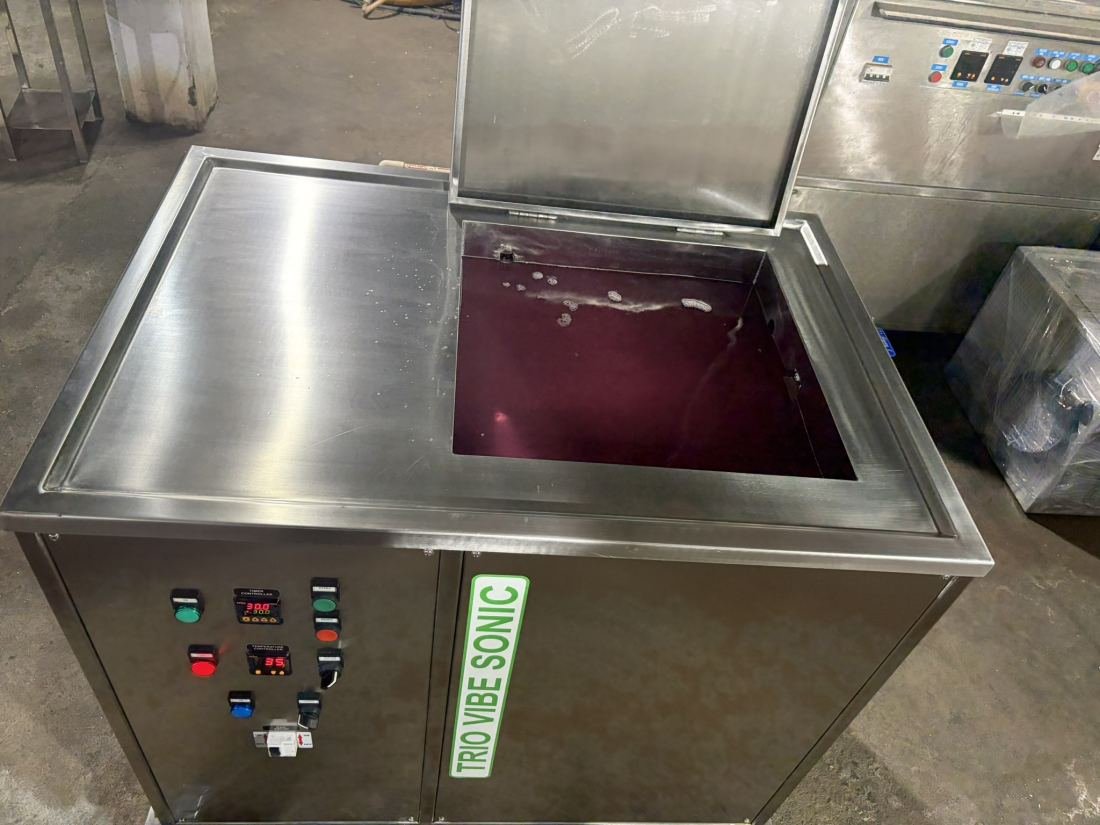
TRIO VIBE SONIC manufactures industrial ultrasonic cleaning systems for precision, reliability and production duty. High-frequency sound waves pass through the cleaning liquid and create millions of microscopic bubbles. Those bubbles implode at the component surface, producing localised energy that lifts oil, grease, carbon, polishing compounds, dust and other contaminants from complex geometry.

Frequency, tank material, power and options such as filtration, chilling, agitation and drying are selected for the contamination and throughput you actually run — not as a generic catalogue setting.

Three steps of ultrasonic cleaning

High-frequency waves, cavitation and contaminant removal — the same physics on tabletop baths and multi-stage production lines.

01

Ultrasonic waves generated

A high-frequency generator drives transducers to emit ultrasonic sound waves, typically at 28 or 40 kHz, through the cleaning solution.

02

Cavitation bubbles form

Pressure variations create millions of microscopic bubbles that form and implode, releasing powerful localised energy bursts at the surface.

03

Contaminants removed

The cavitation energy dislodges oil, grease, carbon, scale and particulates from holes, grooves and complex internal surfaces.

  • Deep precision cleaning
  • No manual scrubbing
  • Cleans small holes and grooves
  • Consistent, repeatable results
  • Saves process time
  • Aqueous, specified chemistry

28 kHz and 40 kHz, selected for the job

Lower frequency delivers more aggressive cavitation for heavy soils. Higher frequency is used for finer contamination and a better surface finish.

28 kHz · Heavy-duty cleaningOil, grease and carbon removal for automotive and engineering parts on production and maintenance duty.
40 kHz · Precision cleaningFine particles and light contamination for medical, dental, electronics and high-value components.

What we engineer around the process

Generators and transducersMatched ultrasonic power for stable, repeatable cavitation in the tank.
SS304 / SS316 tanksIndustrial construction sized to the basket envelope and working volume.
FiltrationRecirculating cartridge or bag filtration to keep the bath clean in production.
Chiller and temperatureHeating or refrigeration when the process needs a held bath temperature.
Agitation and handlingBasket motion, rotary drums and transfer when nested parts need solution exchange.
Automation and dryingPLC/HMI, multi-stage lines and drying when the process is more than a single tank.

Industries that use this process

Automotive
Electronics
Aerospace
Medical
Jewellery & optics
Laboratory
Precision engineering
Maintenance
Ambattur Industrial Estate, Chennai – 600058

Match the frequency to your process

Share the component, contamination and throughput. We will recommend tank, frequency, power and options, then send a datasheet.